
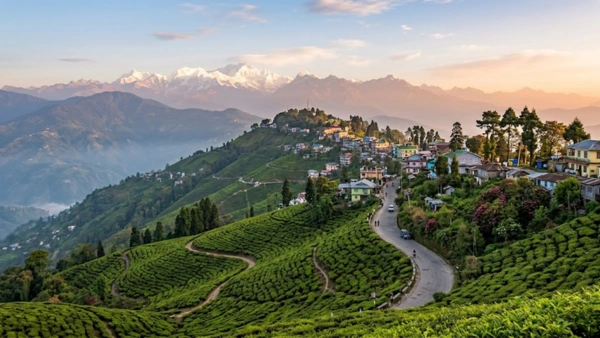
Tucked at an elevation of about 1,458 metres (4,864 feet) in the Darjeeling Hills of West Bengal, Kurseong is one of those rare places that hasn’t yet been swallowed by mass tourism. While its more famous neighbour Darjeeling draws the crowds, Kurseong quietly holds its own — with misty tea gardens rolling across hillsides, colonial-era bungalows, a charming toy train route, and a pace of life that feels genuinely unhurried.
The name Kurseong is derived from the Lepcha word Kharsang, meaning “Land of the White Orchid.” It is a sub-divisional town under the Darjeeling district and sits on the lower Himalayan range. For first-time visitors looking to experience the genuine soul of the Darjeeling Hills without the rush of a popular tourist circuit — Kurseong is the right choice.
How to Reach Kurseong
By Train (The Toy Train — Darjeeling Himalayan Railway)
The most iconic and memorable way to arrive in Kurseong is aboard the Darjeeling Himalayan Railway (DHR), a UNESCO World Heritage Site since 1999. The narrow-gauge steam locomotive — colloquially called the “Toy Train” — runs between New Jalpaiguri (NJP) and Darjeeling, halting at Kurseong along the way. The journey through tea gardens, forests, and winding loops is an experience in itself. The Batasia Loop near Darjeeling and the Agony Point loop near Kurseong are especially scenic sections. Note that schedules and steam engine availability can vary, so check with Indian Railways (IRCTC) or the DHR office before your trip.
By Road
Kurseong is approximately 30 km from Darjeeling and around 45 km from Siliguri. Shared jeeps (Tata Sumo or Bolero) are the primary mode of road transport in these hills and run regularly between NJP/Siliguri, Kurseong, and Darjeeling. The NH10 and the Hill Cart Road (also called Pankhabari Road) are the main road arteries connecting the plains to Kurseong. Road journeys offer stunning views but can take longer due to traffic and narrow mountain curves.
By Air
The nearest airport is Bagdogra Airport, roughly 40 km from Kurseong. Bagdogra is well-connected to Kolkata, Delhi, Mumbai, Guwahati, and several other Indian cities. From Bagdogra, shared taxis and prepaid jeeps are available directly to Kurseong.
Best Time to Visit
October to December is widely considered the best period. The monsoon retreats by late September, leaving the hills washed clean and the skies clear. You get crisp air, excellent mountain views (including Kanchenjunga on clear mornings), and lush green tea gardens.
March to May is the spring season — the second-best window. Temperatures are pleasant, rhododendrons bloom across the slopes, and the tea gardens are alive with the activity of the first flush harvest.
Monsoon (June to September) brings heavy rainfall, landslides, and road disruptions — not recommended for first-time visitors, though the hills turn dramatically green.
Winter (January–February) can be cold with temperatures dropping close to 4–5°C at night. This is a quieter, more atmospheric time if you enjoy mist-draped mornings and near-empty streets.
Where to Stay
Kurseong has a range of accommodation options, from heritage bungalows to budget guesthouses.
Heritage and Boutique Stays: The Cochrane Place is one of the most well-regarded heritage properties in Kurseong — a restored colonial-era bungalow set within a working tea estate. It offers immersive stays with views over the Terai plains and access to tea garden walks. Makaibari Bungalow, associated with the famous Makaibari Tea Estate, is another notable heritage option.
Mid-Range: Several guesthouses and homestays have opened in the town and its surrounding villages in recent years, offering clean rooms and home-cooked meals. These are increasingly popular with travellers seeking authentic local interaction.
Budget: Basic lodges and dharamshalas are available in and around the main market area. Facilities are simple but functional.
Key Attractions
1. Makaibari Tea Estate
Makaibari is one of the oldest and most celebrated tea estates in Darjeeling, established in 1859. It was the first tea estate in the world to receive organic and biodynamic certification. Makaibari produces single-origin teas that have fetched record auction prices globally. Visitors can take guided walks through the estate, watch the leaf plucking process (seasonal), and learn about the tea-making process from withering to drying. The estate also has a community programme where travellers can experience village life and stay with local families.
2. Eagle’s Craig Viewpoint
Eagle’s Craig is a popular viewpoint on the outskirts of Kurseong town. On clear mornings — particularly between October and December — the Kanchenjunga massif and other Himalayan peaks are visible from here. Sunrise visits are especially rewarding. The viewpoint is a short walk or a taxi ride from the town centre.
3. Dow Hill
About 6 km from Kurseong town, Dow Hill is best known for the Victoria Boys’ High School (established 1879) and the Dow Hill Girls’ School (now Forest Institute). The forest surrounding Dow Hill is dense, beautiful, and somewhat notorious in local legend — it has a reputation as one of India’s most “haunted” forests, though that is largely a product of rumour and tourism literature. Forest walks through the pine and oak trees here are genuinely peaceful and worth doing regardless of the mythology.
4. St. Mary’s Hill Church
Built during the British colonial period, St. Mary’s Hill Church is a historic Catholic church perched on a ridge near Kurseong. The church and its surrounding grounds offer quiet views over the hills and plains. It remains an active place of worship.
5. Netaji Subhash Chandra Bose Museum
A small but meaningful museum in Kurseong dedicated to Netaji Subhash Chandra Bose, the freedom fighter who passed through and had connections to this region. The museum houses photographs, documents, and memorabilia related to his life and the Indian independence movement.
6. Ambotia Tea Estate and Forest Bungalow
Another of Kurseong’s historic tea estates, Ambotia offers an older, less commercialised glimpse into estate life. The forest bungalow here is available for stays and provides a quiet, off-the-beaten-path alternative to more popular accommodations.
7. Gidda Pahar Viewpoint
Located a few kilometres above Kurseong, Gidda Pahar is a quieter viewpoint that rewards early risers with views of the surrounding hills, tea gardens, and — on clear days — the distant Himalayan range.
8. Kurseong Market and Town Centre
The town’s main market stretches along the Hill Cart Road and is a lively, unpretentious place to walk through. You’ll find shops selling Darjeeling tea (both genuine and tourist-grade — ask about provenance), local woolens, bamboo crafts, and everyday goods. The town also has several small eateries and bakeries serving momos, thukpa, noodles, and local snacks.
Tea Culture: The Soul of Kurseong
The hills around Kurseong form part of the broader Darjeeling tea belt — one of the most famous tea-growing regions in the world. The area’s tea estates include Makaibari, Ambotia, Castleton, Thurbo, and others. Darjeeling teas are the only teas with a Geographical Indication (GI) tag in India, meaning authentic Darjeeling tea can legally come only from this specific region.
If you are a tea enthusiast, visiting an estate during the flush season is essential. The first flush (March–April) produces light, floral teas. The second flush (May–June) is richer and more muscatel in character — the muscatel notes, a distinctive floral-fruity flavour unique to Darjeeling, come partly from the feeding of a leafhopper insect on the tea leaves. Autumn flush (October–November) produces another distinctive style.
When buying tea in Kurseong, buying directly from estate shops or reputable local stores is advisable. Many counterfeit or diluted Darjeeling teas circulate in tourist markets.
Food and Local Cuisine
Kurseong’s food scene reflects its Gorkha, Nepali, Bengali, and Tibetan heritage.
Momos are the ubiquitous snack — steamed or fried dumplings filled with vegetables, pork, chicken, or buff (buffalo). Every small eatery and roadside stall serves them.
Thukpa is a hearty noodle soup of Tibetan origin, perfect for cold evenings.
Sel Roti is a traditional Nepali/Gorkha sweet ring-shaped bread made from rice flour — often eaten at festivals but available year-round at local stalls.
Gundruk is a fermented leafy green vegetable (typically mustard or radish leaves), a Nepali staple with a sour, pungent flavour. It appears in local home cooking and some small restaurants.
Dal Bhat — lentil soup with rice and seasonal vegetables — is the everyday staple of local households and available at local dhabas.
Tea, of course, is the drink. Locals typically drink chiya — strong milky tea brewed with ginger and cardamom. But you can also find black Darjeeling tea served properly in estate guesthouses and certain cafes.
Getting Around Kurseong
The town itself is compact and much of the central area can be explored on foot. For outlying areas — tea estates, viewpoints, Dow Hill — shared jeeps and private taxis are the standard options. There are no auto-rickshaws or app-based cabs in Kurseong. Local taxi stands are located near the market and the railway station.
Practical Information
Language: Nepali is the primary spoken language, followed by Bengali and Hindi. English is understood in most hotels, guesthouses, and tourist-facing shops.
Connectivity: Mobile connectivity (primarily Airtel, Jio, and BSNL) is available in the town but can be patchy in the more remote tea estates and forest areas. WiFi is available at most mid-range and above accommodations.
Currency: Kurseong is entirely a cash economy for everyday transactions. Carry sufficient Indian rupees. The nearest ATMs are in the main market area, but availability can be unreliable — it is advisable to carry cash from Siliguri or NJP.
Altitude: At around 1,458 metres, Kurseong is not high enough to cause altitude-related illness for most visitors. No acclimatisation is required.
Health: The tap water in hill towns should not be consumed directly. Stick to bottled water or boiled water. Basic medical facilities are available in the town; serious cases require travel to Siliguri.
Clothing: Even in summer, evenings and early mornings are cool. Carry a light woollen layer year-round. In winter, warm woolens and a windproof jacket are essential.
Electricity: Power cuts are common, particularly during monsoon. Most guesthouses have backup inverters or generators for basic lighting.
Cultural Sensitivity and Responsible Travel
The majority of Kurseong’s population is of Nepali/Gorkha origin, with significant Tibetan, Lepcha, and Bengali communities. The region has historically experienced political tension related to the demand for a separate Gorkhaland state — visitors should be aware of this context and approach conversations on the subject with sensitivity.
Tea estate workers are among the lower-income communities in this region, and their labour is the foundation of the entire Darjeeling tea economy. Supporting estates that practice fair trade, organic farming, and community welfare programmes — like Makaibari — is a meaningful way to travel responsibly.
Littering is a serious environmental issue in hill towns. Please carry your waste until you find a proper bin or take it back with you.
A Suggested Itinerary for 3 Days
Day 1: Arrive in Kurseong via toy train or road. Check in and acclimatise. Evening walk through the town market. Dinner at a local eatery — try momos and thukpa.
Day 2: Morning visit to Eagle’s Craig or Gidda Pahar for sunrise views. Post-breakfast, full day at Makaibari Tea Estate — guided walk, tea tasting, lunch. Late afternoon back in town; explore St. Mary’s Hill Church.
Day 3: Morning visit to Dow Hill and forest walk. Afternoon: Netaji museum and last-minute tea shopping in the market. Depart or extend to Darjeeling (30 km, about 1.5 hours by road).
Final Thoughts
Kurseong is a town that rewards slowness. It doesn’t offer the dramatic urban energy of Darjeeling, the adventure infrastructure of Manali, or the pilgrimage draw of Rishikesh. What it offers is something quieter and more lasting: mist drifting over tea gardens at dawn, the distant whistle of a steam locomotive, the smell of fermenting leaves in a factory shed, a cup of second-flush Darjeeling on a cold morning.
For first-time visitors to the Darjeeling Hills, Kurseong is not just a stopover — it is an experience worth planning for in its own right.
