
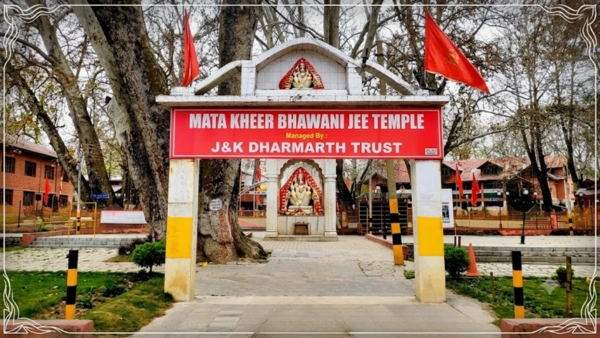
If you are planning a spiritual journey to one of Kashmir’s most sacred shrines, understanding the distance from Srinagar to Kheer Bhawani Temple and the travel options available is the very first step. Whether you are a devout Hindu pilgrim, a Kashmiri Pandit making a sentimental homecoming, or simply a traveller curious about the valley’s mystical heritage, this guide covers everything — from exact distances and routes to history, best time to visit, and practical tips.
Where Is Kheer Bhawani Temple Located?
Kheer Bhawani Temple is a Hindu temple situated at Tulla Mulla village near Srinagar, in the Ganderbal district of Jammu and Kashmir. The temple is constructed over a natural sacred spring and is dedicated to Goddess Ragnya Devi, an incarnation of Hindu Goddess Parvati. The term “kheer” refers to a milk and rice pudding that is offered to propitiate the goddess — essentially translating as the “Milk Goddess.”
The temple sits at an elevation of about 1,592 metres above sea level, surrounded by ancient chinar trees that give the entire complex a deeply serene and timeless atmosphere.
Exact Distance from Srinagar to Kheer Bhawani Temple
The temple is located at a distance of approximately 25 km from Srinagar. The road distance is about 14.1 miles (roughly 22–23 km by road), and it takes approximately 22 minutes to drive this stretch.
So to summarise the key distance figures:
- Straight-line distance from Srinagar city centre: approximately 14 miles (22–23 km)
- Road distance: approximately 14.1 miles (about 23 km)
- Travel time by car or taxi: approximately 22 to 40 minutes depending on traffic
- Distance from Srinagar Airport to the temple: approximately 30–33 km
The journey is short, smooth, and entirely doable as a half-day trip from Srinagar, making it one of the most accessible pilgrimage sites in the Kashmir Valley.
Route from Srinagar to Kheer Bhawani Temple
The best route to reach Kheer Bhawani Temple from Srinagar is via the Srinagar-Tangmarg Highway (NH1D). The road passes through the scenic outskirts of Srinagar before entering the lush green landscapes of Ganderbal district, offering pleasant views of the Kashmir Valley en route.
The drive is straightforward with clear signage. Once you reach Tulmulla village, the temple is easy to locate, and directions from locals are always available.
How to Reach Kheer Bhawani Temple from Srinagar
1. By Taxi or Cab (Most Recommended)
The fastest and most comfortable way to get from Srinagar to Kheer Bhawani Temple is by taxi, which takes about 22 minutes. Srinagar taxi services, Tourist Taxi operators, and Srinagar Taxi Service all run cabs on this route. The cost of hiring a cab typically ranges from INR 300 to INR 700 for a one-way trip, depending on the vehicle and negotiation.
For pilgrims who want to visit in comfort and return at their own pace, hiring a private taxi for the full day is the most convenient option.
2. By Bus (Budget-Friendly)
For a more budget-friendly option, you can take a bus from Srinagar bus stand to Kheer Bhawani Temple. Many private and government-owned buses operate between the two places, with fares reasonably priced between INR 50–100.
Buses drop passengers at or near Tulmulla village, from where the temple is a short walk away.
3. By Private Car (Self-Drive)
Visiting Kheer Bhawani Temple by private car gives you the freedom to explore the place at your own pace. The road is well-maintained, and the drive is pleasant, especially in summer when the valley is in full bloom. Parking is available near the temple complex.
4. From the Airport
The total distance between the temple and Srinagar Airport is about 30 km and takes 40–45 minutes to reach. Cabs and taxis are easily available from the airport. If you have just landed in Srinagar and want to begin your pilgrimage right away, this is a viable option.
5. By Train (Arriving from Outside Kashmir)
Srinagar does not have its own railway station. The nearest railway station is Udhampur, situated about 130 km from Srinagar. From Udhampur, you can hire a bus or taxi to Srinagar and then proceed to the temple. The nearest railway station connected closely to the Ganderbal district is at Jammu, which is around 295 km from the temple. Buses or taxis can be hired from there as well.
About Kheer Bhawani Temple: History and Significance
Ancient Origins
The mention of Kheer Bhawani is found in Kalhana’s Rajtarangini, one of the earliest historical chronicles of Kashmir. Kalhana writes that the sacred spring of Tula Mula is situated in a marshy ground, and thousands of years ago, floods inundated the spring and temple.
Its origins are steeped in ancient legends. One story claims that Ravana, the demon king of Lanka, once worshipped Goddess Bhawani here. Maha Rishi Kashyapa, an important sage, is also believed to have meditated here, and later, a temple was built at this location.
According to another legend, Goddess Ragnya Devi moved her abode from Sri Lanka to Kashmir, making this site one of the most sacred for Hindus.
Construction and Renovation
The current structure of the spring, temple pond, and temple itself was established during the 1910s under the rule of Maharaja Pratap Singh of Jammu and Kashmir, with further renovations carried out by Maharaja Hari Singh. The temple area is adorned with ancient chinar trees.
Spiritual Importance for Kashmiri Pandits
It is the most important temple for the Kashmiri Hindus in Kashmir, known as Kashmiri Pandits. The worship of Kheer Bhawani is universal among the Hindus of Kashmir, most of whom worship her as their protective patron deity — the Kuladevi. For thousands of Kashmiri Pandits who were forced to leave the valley in the 1990s, a visit to this temple is a deeply emotional pilgrimage back to their roots.
Devotees believe that offering prayers at this temple brings good health, prosperity, and happiness.
The Mystical Spring: The Heart of the Temple
The most captivating and unique feature of Kheer Bhawani Temple is its sacred spring — a heptagonal (seven-sided) water body at the centre of the temple complex.
This holy spring is known for its remarkable ability to change colours, displaying hues of red, pink, orange, green, blue, and white.
The spring located near the temple is believed to change colour in different seasons depending on the mood of the Goddess. The black colour is a symbol of upcoming disaster and catastrophe in the valley.
It was reportedly observed that the spring’s colour turned black during the time of the Kashmiri Pandit Exodus, an event deeply etched in the community’s collective memory.
In 1886, Walter Lawrence, the then British settlement commissioner for land, during his visit to the spring, reported the water having a violet tinge.
This colour-changing phenomenon is one of the greatest mysteries of the Kashmir Valley. Science has not been able to fully explain it, and for devotees, no explanation is needed — it is simply the voice of the Goddess herself.
Mela Kheer Bhawani: The Annual Festival
Mata Kheer Bhawani Temple Mela marks one of the biggest religious gatherings in the Kashmir Valley. It is celebrated during the Jyestha Ashtami in the month of May–June. As the Mela starts, the pilgrims walk barefoot to the temple with flowers, milk, and kheer to offer the Goddess. They start by taking a holy dip in the nearby spring and then offer prayers.
Though the festival is relatively significant for Kashmiri Pandits, it does showcase communal harmony, with even Muslims making arrangements of flowers and other offerings for devotees. This beautiful coming together of communities is one of the most heartwarming aspects of the Mela.
Throughout the years, the Kheer Bhawani Mela has evolved into a symbol of communal harmony and fraternity in Kashmir.
Best Time to Visit Kheer Bhawani Temple
The best time to visit Kheer Bhawani Temple near Srinagar is during May or June (Jyeshtha Ashtami), specifically for the annual Mela Kheer Bhawani, when thousands gather to offer prayers, kheer, and milk. This is the most auspicious time. For a quieter experience, April to October offers pleasant weather and serene surroundings.
Avoid visiting in the harsh winter months (December to February), when snowfall can make roads slippery and the environment extremely cold.
Practical Tips for Visiting Kheer Bhawani Temple
1. Register at the entrance gate. The temple is guarded by soldiers from all around, and many devotees visit here, so while visiting, devotees first need to register near the entrance gate. Carry a valid ID for registration.
2. Dress modestly. As with all Hindu religious sites, modest clothing covering shoulders and knees is expected and respectful.
3. Remove footwear. You will be required to remove shoes before entering the temple complex.
4. Carry kheer or milk as an offering. Offering the traditional kheer (rice pudding made with milk and sugar) to the Goddess is the most significant ritual here. You can purchase it near the temple or prepare it yourself.
5. Go early in the morning. Visiting at dawn gives you a peaceful, crowd-free experience and the most spiritually charged atmosphere.
6. Combine with nearby attractions. Since the temple is only 25 km from Srinagar, you can easily combine this visit with Dal Lake, Hazratbal Shrine, or Shankaracharya Temple in the same day.
7. Accommodation. There are 690+ hotels available in and around the Kheer Bhawani Temple area, ranging from budget guesthouses to comfortable hotels in Srinagar itself.
Summary: Distance and Travel Facts at a Glance
| Distance from Srinagar | 25 km by road |
| Travel time by car/taxi | 22 to 40 minutes |
| Distance from Srinagar Airport | 30–33 km |
| Best route | Via Srinagar-Tangmarg Highway (NH1D) |
| Budget travel | Bus — INR 50–100 |
| Premium travel | Taxi — INR 300–700 |
| Best time to visit | May–June (Mela) or April–October |
| Nearest city | Srinagar |
| Temple location | Tulmulla village, Ganderbal district |
Final Thoughts
The distance from Srinagar to Kheer Bhawani Temple is short in kilometres but immense in spiritual significance. Barely 25 km from the heart of the city, this ancient shrine carries the weight of centuries of faith, legend, and devotion. Whether you are drawn by the mystical colour-changing spring, the soul-stirring Mela, or simply the need for peace amid Kashmir’s natural grandeur, a visit to Kheer Bhawani Temple is an experience that will stay with you long after you leave. Plan your trip, pack your offering of kheer and milk, and let the Goddess of the Valley welcome you home.
