
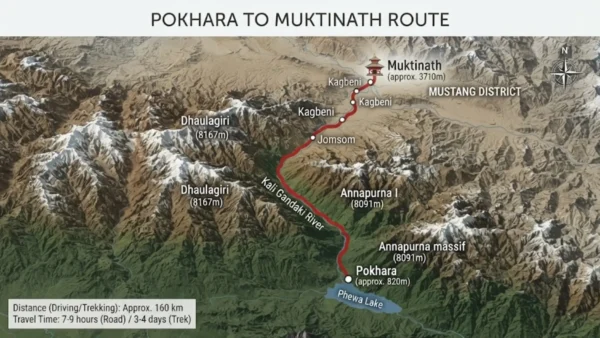
Muktinath Temple is one of the most revered pilgrimage sites in the Himalayas, sacred to both Hindus and Buddhists, sitting at an altitude of roughly 3,710 to 3,800 metres in Nepal’s Mustang district. For most pilgrims and trekkers, Pokhara is the natural starting point for this journey, both because of its accessibility from Kathmandu and because it sits closest to the Annapurna and Mustang region. This guide breaks down the distance, route options, travel times, costs, and practical planning details for anyone preparing to undertake this journey.
Pokhara to Muktinath Distance: What the Numbers Actually Say
If you search for the exact distance from Pokhara to Muktinath, you’ll notice the figure isn’t fixed; it varies depending on the specific road route taken, ongoing construction, and which travel operator is quoting it. Most current sources place the overland road distance somewhere between 170 km and 200 km, with the commonly cited range being around 195 to 197 km via the standard jeep route through Beni, Tatopani, and Jomsom. Some operators quote figures closer to 170-180 km depending on whether they’re measuring via slightly different mountain alignments. A small number of older or less reliable sources cite distances well over 300 km, but these appear to be outliers and likely reflect outdated or alternate routing rather than the standard pilgrimage path.
For practical planning purposes, it’s safest to think of the journey as roughly 195 km of mountain road, broken into three distinct sections, each with very different road conditions.
The Route Breakdown: Pokhara to Beni to Jomsom to Muktinath
Pokhara to Beni (approximately 100-110 km): This first stretch is the easiest part of the journey, running on a paved, relatively smooth road. It typically takes about 3 hours by jeep or private vehicle.
Beni to Jomsom (approximately 65-70 km): This is where the journey becomes genuinely adventurous. The road runs through the Kali Gandaki Valley, past Tatopani, Ghasa, Kalopani, and Marpha, and is largely unpaved, rough, and prone to landslides or muddy stretches depending on the season. This section alone can take 4 to 5 hours even though the distance is modest, because of the terrain. A high-clearance 4WD vehicle is strongly recommended, and during monsoon months a regular car may struggle or get stuck entirely.
Jomsom to Muktinath (approximately 19-21 km): The final stretch passes through Kagbeni and Jharkot before reaching Muktinath. This section is paved again and considerably smoother, taking around 1 hour by jeep.
Added together, the total driving time from Pokhara to Muktinath typically runs between 8 and 11 hours if done in a single day, though most experienced operators and pilgrims strongly recommend splitting the journey across two days with an overnight halt, usually at Jomsom or Tatopani, both to rest and to allow some altitude acclimatisation before reaching Muktinath’s higher elevation.
Three Ways to Make the Journey
By private jeep (most popular option): A 4WD jeep, commonly a Mahendra Scorpio, Tata Sumo, or for more comfort a Toyota Land Cruiser, is the standard choice for this route. Hiring a private jeep for the full vehicle (seating up to 6-7 people) typically costs between USD 110 and 250 depending on the vehicle type and season, while shared jeep seats run considerably cheaper, often in the range of NPR 1,500-2,500 per seat. This option offers the most flexibility for stops at waterfalls, hot springs, and villages along the way.
By local bus: A budget option that follows the same overland route but takes longer, often 10-11 hours or more, and offers less comfort on the rough sections beyond Beni. This suits travelers prioritising cost over time and comfort.
By flight (Pokhara to Jomsom, then jeep to Muktinath): This is by far the fastest option. A scenic mountain flight from Pokhara to Jomsom takes around 25-35 minutes, weather permitting, followed by a roughly 1 to 2 hour jeep ride from Jomsom to Muktinath. Door-to-door, this route can be completed in 2 to 3 hours total, compared to a full day by road. Flights are weather-dependent and best booked in advance during peak pilgrimage season, as they’re frequently affected by morning wind conditions in the mountains and can be delayed or cancelled.
Best Time to Travel This Route
The road and flight conditions on this route are heavily influenced by season. Spring (March to May) and autumn (September to November) are considered the best windows, offering stable weather, clear mountain visibility, and the least disruption from landslides or snow. Monsoon season (July-August) brings a real risk of landslides along the Beni-to-Jomsom stretch and is generally discouraged for road travel. Winter (December to February) is passable but more challenging, with snow appearing on the higher sections of the route from late November through March, making the roads slippery and travel times less predictable.
Permits Required for the Journey
Since the route to Muktinath passes through the Annapurna Conservation Area, all travelers, including Indian pilgrims, need an Annapurna Conservation Area Permit (ACAP). Costs vary by nationality, with SAARC nationals paying a lower fee than other foreign travelers. Indian citizens do not need a visa to enter Nepal, which makes this one of the more accessible international pilgrimages for Indian travelers, though carrying valid identification and completing permit formalities in Pokhara before departure is essential.
What to Expect Along the Way
The journey itself is as much a part of the pilgrimage experience as the destination. Travelers pass through the Kali Gandaki Gorge, recognised as one of the deepest gorges in the world, along with highlights like the Tatopani hot springs, the dramatic Rupse Waterfall, Marpha’s apple orchards, and the traditional Mustang-style villages of Kagbeni and Jharkot, where the landscape shifts dramatically from green Pokhara valley scenery to the stark, high-altitude terrain typical of the Tibetan plateau. Many pilgrims also choose to combine the road journey with a short trek between Jomsom and Muktinath via Kagbeni, which offers closer views of the Thorong La pass region for those with the time and stamina.
What to See Around There
Muktinath itself is only part of the experience; the surrounding Mustang region is dense with sites worth building extra time for, both at the temple and along the route.
Muktinath Temple complex: Inside the main temple, dedicated to Lord Vishnu, pilgrims walk around 108 stone water spouts shaped like bull heads, believed to offer purification when bathed under, a ritual most Hindu pilgrims complete despite the icy water. Within the same complex sits the Jwala Mai Temple, home to a natural gas flame that burns continuously beside a small spring, considered sacred by Buddhists as the eternal flame and a key reason the site is also revered in Tibetan Buddhism. Nearby, the Mukteshwor Mahadev Temple and Samba Gompa, a Buddhist monastery, round out the spiritual significance of the complex.
Kagbeni: A striking medieval-style village just before Muktinath, Kagbeni sits at the confluence of the Kali Gandaki and Jhong rivers and marks the traditional entry point into Upper Mustang. Its narrow alleys, mud-brick houses, and an old monastery make it a popular stop for both pilgrims performing ancestral rites (Pind Daan) and trekkers.
Jharkot: A short distance from Muktinath, this well-preserved fortified village offers some of the best views of the Annapurna and Dhaulagiri ranges, along with an old monastery and a traditional Tibetan medicine centre worth a quick visit.
Jomsom: As the administrative hub of the Mustang region, Jomsom is worth a stop for its windswept high-altitude landscape, the Mustang Eco Museum, and as a gateway point if continuing further into Upper Mustang and Lo Manthang for those with extra time and the required restricted-area permit.
Marpha: Known as Nepal’s apple capital, this clean, whitewashed village along the route is famous for its orchards, locally distilled apple brandy, and the Marpha Monastery, making it a popular overnight or lunch stop for travelers heading to or from Muktinath.
Tatopani: Literally meaning “hot water,” this village is home to natural hot springs along the Kali Gandaki riverbank, a welcome stop for travelers to soak and recover after the rough Beni-to-Jomsom road stretch.
Kali Gandaki Gorge: Recognised as one of the deepest gorges in the world, with Dhaulagiri and Annapurna peaks rising on either side, the gorge itself is a continuous visual highlight throughout the middle section of the journey, even for those not stopping anywhere specific.
Pokhara (before or after the trip): Many pilgrims extend their trip by a day or two in Pokhara itself, visiting Phewa Lake and the Tal Barahi Temple on its island, the World Peace Pagoda, Devi’s Fall, and the Bindabasini Temple, making it a worthwhile base both before departure and on return.
What to See Around There
The Muktinath and Mustang region rewards travelers who build in time beyond just the temple darshan, since the area around the route is dense with sites worth visiting.
Muktinath Temple Complex: Beyond the main shrine, the complex includes the 108 sacred water spouts known as Mukti Dhara, where pilgrims take a ritual bath believed to cleanse sins, along with the eternal natural flame at Jwala Mai Temple, considered a rare and sacred phenomenon since it burns on a combination of natural gas and water. The nearby Narsingha Gompa and Mukteshwor Mahadev Temple are also part of the pilgrimage circuit and typically visited in the same trip.
Kagbeni: A short distance before Muktinath, this medieval Mustang-style village sits at the confluence of two holy rivers and is a popular spot for ancestral rituals (Pitri Tarpan). Its narrow alleys, mud-brick houses, and old monastery offer a glimpse of traditional Mustang life largely unchanged for centuries, and it also serves as the gateway to Upper Mustang for travelers with additional permits.
Jomsom: The administrative hub of the region and a common overnight stop, Jomsom offers views of Nilgiri and Dhaulagiri peaks, a small but informative museum on Mustang’s culture and history, and is the starting point for both the Jomsom-Muktinath flight route and onward trekking trails.
Marpha: Known as Nepal’s apple capital, this charming village is famous for its whitewashed stone houses, apple orchards, and locally distilled apple brandy. It’s a popular stop for travelers heading toward or returning from Muktinath and offers some of the best food and lodging options along the route.
Tatopani: Literally meaning “hot water,” this village is home to natural hot springs that are a favourite stop for travelers easing sore muscles after a long day on rough mountain roads. It’s also close to the Rupse Waterfall, one of the most photographed waterfalls along the route.
Kali Gandaki Gorge: Recognised as one of the deepest gorges in the world, this dramatic valley runs along much of the Beni-to-Jomsom stretch and is worth slowing down for, both for its scale and for the striking contrast between the lush lower valley and the arid, high-altitude Mustang landscape further north.
Upper Mustang (for those with extra time): For travelers willing to extend their trip and obtain the additional Restricted Area Permit, the walled city of Lo Manthang and the surrounding Upper Mustang region offer one of the last remaining strongholds of traditional Tibetan Buddhist culture, with centuries-old monasteries, cave dwellings, and landscapes that feel closer to the Tibetan plateau than to Nepal’s greener south.
Final Travel Tips
Given the altitude gain and the roughness of the middle section of the route, it’s worth keeping a few practical points in mind. Carry warm layers regardless of season, since temperatures drop sharply at higher elevations even when Pokhara is warm. Book jeeps and, especially, flights in advance during peak pilgrimage months, as availability tightens considerably. Finally, building in a buffer day for weather delays, particularly if relying on the Jomsom flight, is a wise precaution, since mountain flights in this region are frequently rescheduled due to wind and visibility conditions.
Whichever mode of travel you choose, the journey from Pokhara to Muktinath remains one of the most scenically rewarding pilgrimage routes in the Himalayas, offering a rare combination of spiritual significance and dramatic mountain landscape that few other routes in Nepal can match.
