
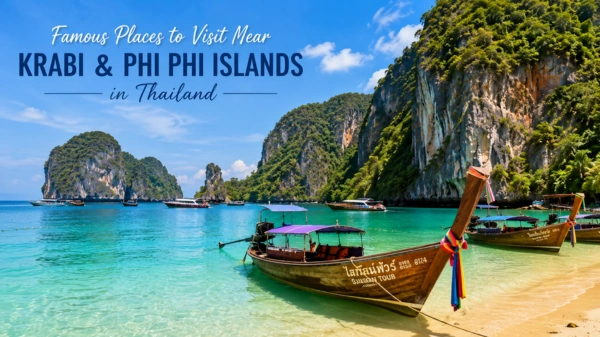
Krabi and the Phi Phi Islands sit on Thailand’s Andaman coast, and together they form one of the country’s most popular travel combinations. Krabi offers dramatic limestone cliffs, mangrove forests, and easy access to smaller islands, while Phi Phi delivers the turquoise lagoons and postcard beaches that made this stretch of coastline famous worldwide. Most travelers combine both destinations in a single trip, hopping between the mainland and the islands by ferry. Here’s a complete guide to what to see, do, and how to plan your time across both.
Best Places to Visit Near Krabi
Railay Beach is arguably Krabi’s biggest draw, and it isn’t actually an island — it’s a peninsula accessible only by longtail boat because sheer limestone cliffs cut it off from the road network. It’s split into East Railay (mangroves, sunset views), West Railay (the main beach with resorts and restaurants), and Phra Nang Beach, known for its clear water and a small cave shrine dedicated to a local sea goddess. Railay is also one of Southeast Asia’s premier rock-climbing spots, with routes suited to complete beginners and experienced climbers alike.
Ao Nang is Krabi’s main tourist hub — a beach town packed with hotels, restaurants, dive shops, and tour operators. It’s the most convenient base for day trips to nearby islands and beaches, and it has a lively night market and beachfront promenade.
Tiger Cave Temple (Wat Tham Suea) sits a short drive from Krabi Town and is famous for its 1,237-step staircase leading to a golden Buddha statue and panoramic views over the surrounding jungle and limestone karsts. It’s a demanding climb but one of the most rewarding viewpoints in the region.
Krabi Town itself is smaller and more low-key, with a riverside night market, temples, and access to the Krabi River mangrove tours where you can spot fireflies after dark.
Emerald Pool and Blue Pool (Sa Morakot), located inside Khao Nor Chuchi Wildlife Sanctuary, are freshwater pools fed by natural hot springs, known for their strikingly clear, emerald-green and deep blue coloring. They’re a popular half-day trip combined with the nearby Krabi Hot Springs Waterfall.
Best Islands to Visit Near Krabi
Koh Poda is one of the most photographed islands in the Krabi archipelago — a small, easily accessible island with a long white-sand beach and calm, shallow water good for swimming and snorkeling.
Hong Islands (Koh Hong) are a cluster of islands famous for their hidden lagoon, reached by boat through a narrow channel between limestone cliffs. The lagoon’s still, jade-green water surrounded by vertical rock walls makes it one of the most striking sights in the region.
Chicken Island (Koh Kai) gets its name from a distinctive rock formation resembling a chicken’s head, and is a common stop on Krabi’s popular “Four Islands Tour,” alongside Koh Poda, Koh Tup, and Koh Mor.
Koh Lanta, a larger island south of Krabi, is a quieter, more laid-back alternative to Ao Nang and Phi Phi, with long stretches of beach, a relaxed old town, and fewer crowds — good for travelers looking to slow down after island-hopping.
Best Places to Visit Near Phi Phi Islands
Koh Phi Phi Don is the only inhabited island in the Phi Phi group and serves as the arrival point for ferries, as well as the main hub for accommodation, restaurants, and nightlife. Tonsai Village, connecting Tonsai Bay and Loh Dalum Beach, is the busiest and most developed part of the island.
Koh Phi Phi Leh is uninhabited and home to the island group’s most famous sights, including Maya Bay and Pileh Lagoon. It’s typically visited on day trips or boat tours from Phi Phi Don, Krabi, or Phuket rather than as an overnight stay.
Maya Bay, made globally famous by the film “The Beach,” is a stunning cove enclosed by steep cliffs on three sides. Note that Thai authorities have periodically restricted swimming and limited visitor numbers and hours here in recent years to allow the fragile coral ecosystem to recover, so it’s worth checking current access rules before planning your visit.
Pileh Lagoon is a nearly enclosed, jewel-toned lagoon surrounded by towering limestone walls, often visited by boat for swimming and snorkeling rather than landing on foot.
Bamboo Island (Koh Mai Phai), a short boat ride from Phi Phi Don, offers a quieter beach experience with good snorkeling and significantly fewer crowds than Maya Bay.
Best Beaches Near Krabi & Phi Phi Islands
- Railay Beach (West Railay) — soft white sand backed by dramatic limestone cliffs, ideal for swimming and sunset views.
- Phra Nang Beach — considered one of Thailand’s most beautiful beaches, with clear turquoise water and striking cave formations.
- Loh Dalum Beach (Phi Phi Don) — a wide, shallow bay known for turquoise water by day and a lively party atmosphere by night.
- Long Beach (Phi Phi Don) — quieter than Loh Dalum, popular for snorkeling right off the shore.
- Ao Nang Beach — the main beach fronting Krabi’s tourist strip, convenient but busier and less scenic than Railay.
- Klong Muang Beach — a quieter, upscale beach north of Ao Nang, popular with resort-goers seeking a calmer alternative.
Best Things to Do Around Krabi & Phi Phi Islands
- Island-hopping tours — full-day or half-day boat trips covering multiple islands (Krabi’s Four Islands Tour, or Phi Phi’s Maya Bay–Pileh Lagoon–Monkey Beach–Viking Cave route) are the single most popular activity in the region.
- Rock climbing — Railay and Ton Sai Beach are internationally recognized climbing destinations, with schools offering half-day introductory sessions for beginners.
- Snorkeling and diving — Phi Phi’s surrounding reefs, along with Koh Poda and the Hong Islands near Krabi, offer accessible snorkeling; more serious divers head to sites like Shark Point and Hin Daeng further offshore.
- Sea kayaking through mangroves — particularly around Ao Thalane near Krabi, where kayakers paddle through limestone caves and tidal channels.
- Sunset viewpoints — Krabi’s Railay Viewpoint and various vantage points on Phi Phi (like the famous Phi Phi Viewpoint above Tonsai) offer sweeping views over the bays below.
- Visiting Monkey Beach — a small beach on Phi Phi Don known for its resident population of long-tailed macaques, usually visited as part of a boat tour.
- Night markets — both Ao Nang and Krabi Town have active night markets with street food, souvenirs, and live music.
Krabi vs Phi Phi Islands: Which Is Better for Your Trip?
Krabi is the better choice if you want a mix of mainland comfort and island access — it has a wider range of accommodation (from budget guesthouses to luxury resorts), more dining variety, and serves as a convenient base for day trips without needing to pack up and move. It’s also generally quieter and more relaxed than Phi Phi, particularly if you stay around Ao Nang, Railay, or Klong Muang.
Phi Phi is the better choice if the beaches and lagoons themselves are the priority, and if you want to be based right where the scenery is, rather than commuting to it by boat each day. It’s also the better pick for nightlife — Phi Phi’s beach parties, especially around Loh Dalum, are livelier and more concentrated than anything in Krabi. The trade-off is that Phi Phi is more crowded, more expensive for what you get, and has fewer non-beach activities.
Most travelers don’t have to choose — since the islands are so close to Krabi, a common approach is to base yourself in Krabi and either take a day trip to Phi Phi, or split your stay between the two.
How to Travel Between Krabi & Phi Phi Islands
Ferries and speedboats connect Krabi (mainly from Klong Jilad Pier, about 4 km from Krabi Town) to Phi Phi’s Tonsai Pier. Standard ferries take roughly 1.5 to 2 hours, while speedboats cut that down to around 45 minutes to an hour. Multiple operators run this route daily — including Songserm, Andaman Wave Master, and Phi Phi Cruiser — with departures scheduled several times throughout the day, so pre-booking isn’t always essential, though it’s recommended in high season.
Ticket prices vary by operator and season, but foot passengers can typically expect to pay somewhere in the range of $15-$40 USD one-way, with speedboats generally costing more than standard ferries. If you’re staying in Railay rather than Krabi Town, some ferries also stop at East Railay pier, saving you an extra transfer. Many hotels and tour desks in Ao Nang also sell combined transfer-plus-ferry packages that include hotel pickup.
Best Time to Visit Krabi & Phi Phi Islands
The best time to visit is during Thailand’s dry season, from November to April, when rainfall is minimal, seas are calmer, and visibility for snorkeling and diving is at its best. December through February is peak season with the most pleasant temperatures, but also the largest crowds and highest prices.
March to April stays dry but gets noticeably hotter and more humid.
May to October marks the southwest monsoon season, bringing heavier rain, rougher seas, and occasional ferry cancellations or delays — though it also means fewer tourists and cheaper accommodation. Some boat tours and island access points (including at times Maya Bay) may have reduced operating hours or temporary closures during this period for environmental recovery, so it’s worth checking current conditions if you’re traveling in the rainy months.
How Many Days Do You Need for Krabi & Phi Phi Islands?
For a reasonably complete experience, 5 to 7 days is a good baseline — enough time to explore Krabi’s mainland attractions, do at least one island-hopping tour, and spend two to three days on Phi Phi itself.
If you’re short on time, 3 to 4 days is workable: two days based in Ao Nang or Railay covering Krabi’s highlights, plus a day trip or one overnight stay on Phi Phi.
Travelers with more flexibility often extend to 10 days or more, adding Koh Lanta for a slower-paced few days, or combining this leg with Phuket, given its proximity and frequent ferry connections.
Suggested Krabi & Phi Phi Islands Itinerary
Day 1: Arrival in Krabi — Settle into Ao Nang or Krabi Town, relax at Ao Nang Beach, and explore the night market in the evening.
Day 2: Railay Beach — Take a longtail boat to Railay for the day. Visit Phra Nang Beach, try a beginner rock-climbing session, and catch sunset from the Railay Viewpoint.
Day 3: Four Islands Tour — Full-day boat trip covering Koh Poda, Chicken Island, Koh Tup, and Koh Mor for swimming and snorkeling.
Day 4: Travel to Phi Phi — Take a morning ferry or speedboat to Koh Phi Phi Don, check into your accommodation, and explore Tonsai Village in the afternoon.
Day 5: Phi Phi Leh Boat Tour — Full-day trip to Maya Bay, Pileh Lagoon, Monkey Beach, and Viking Cave.
Day 6: Relax on Phi Phi — Spend the day at Long Beach or Loh Dalum Beach, or add an optional viewpoint hike for panoramic photos.
Day 7: Departure — Ferry back to Krabi (or onward to Phuket) for your next connection.
Travel Tips for Visiting Krabi & Phi Phi Islands
- Book ferries a day in advance in peak season (December-February), as popular time slots can sell out.
- Bring reef-safe sunscreen — many tour operators and some islands now specifically require it to reduce coral damage.
- Carry cash in smaller denominations for longtail boat rides, island entrance fees, and national park fees, which aren’t always payable by card.
- Pack light, waterproof bags for boat tours, since you’ll frequently be wading ashore or getting splashed.
- Check Maya Bay’s current access rules before your trip, as visiting hours and swimming permissions have changed periodically due to conservation efforts.
- Wear proper footwear for Tiger Cave Temple if you plan to climb the 1,237 steps — flip-flops make the climb considerably harder.
- Avoid the rainy season if snorkeling is a priority, as visibility drops significantly and some boat trips get canceled due to rough seas.
- Stay overnight on Phi Phi at least once if your schedule allows — the island feels completely different once the day-trippers leave in the late afternoon.
Our Opinion
If you can only pick one base for this trip, make it Krabi rather than Phi Phi. Krabi gives you everything Phi Phi does — access to the same lagoons, beaches, and boat tours — without the inflated prices, overcrowding, and limited infrastructure that come with actually staying on Phi Phi Don. Railay Beach in particular offers a genuinely comparable “postcard Thailand” experience to Phi Phi’s beaches, minus the crowds. That said, skipping Phi Phi entirely would be a mistake — Maya Bay and Pileh Lagoon really are as striking in person as in photos, and a one- or two-night stay lets you experience the island in its quieter early-morning and late-evening hours, well before and after the day-trip boats arrive. The ideal approach, if your schedule allows it, is exactly what most seasoned travelers do: base yourself in Krabi, and treat Phi Phi as a short, deliberate side trip rather than your main destination.
FAQs
Q1. Is Phi Phi Island a day trip from Krabi or do I need to stay overnight?
Both are possible. A day trip from Krabi to Phi Phi via speedboat is common and typically includes Maya Bay, Pileh Lagoon, and Monkey Beach. However, staying overnight lets you experience the island once day-trippers leave, and gives more time for the viewpoint hike and beach relaxation.
Q2. How far is Phi Phi Island from Krabi?
Koh Phi Phi is roughly 46 kilometers from Krabi, making it closer than the alternate route from Phuket (around 74 kilometers), which generally makes the Krabi crossing quicker and cheaper.
Q3. Can you swim at Maya Bay?
Swimming access at Maya Bay has been restricted at various points in recent years to protect the coral reef, with limited visiting hours enforced. It’s best to check current regulations closer to your travel dates, as rules have changed periodically.
Q4. Is Railay Beach part of Krabi?
Yes, Railay is part of Krabi province, but it’s a peninsula cut off from the mainland road network by limestone cliffs, so it’s only reachable by longtail boat from Ao Nang or Krabi Town.
Q5. What is the cheapest way to get from Krabi to Phi Phi?
Standard ferries are cheaper than speedboats, typically taking 1.5 to 2 hours compared to 45 minutes to an hour on a speedboat, with fares generally in the $15-$25 range for ferries versus higher prices for faster boats.
Q6. Is Koh Lanta worth visiting along with Krabi and Phi Phi?
Yes, if you have extra time. Koh Lanta offers a quieter, slower-paced alternative to the more touristy Ao Nang and Phi Phi, with long beaches and a relaxed old town, making it a good add-on for travelers wanting a few unhurried days.
